
Despite all the advancements and wonders of modern manufacturing, key bottlenecks continue to hinder manufacturers’ ability to meet rising demand.
One such bottleneck is manual inspection techniques. Time-consuming, inconsistent, and labour-intensive, they are often the weakest links in modern manufacturing.
Unfortunately, this continued bottleneck comes at a time of heightened consumer expectations and ever more scrupulous regulations. This means that manufacturers can no longer rely on outdated shadow graphs, vernier callipers, or traditional Coordinate Measuring Machines (CMMs).
This guide explores how automated inspection and modern industrial metrology tools like Micro‑Vu systems are transforming quality control in manufacturing.
We’ll unpack why manufacturers are moving to automation, break down the limits of manual inspections, and show how digital data ensures traceability and compliance. To prove the power of an evolved inspection system, we’ll also look at a real-world example of how Micro-Vu helped a firm go from clunky shadow graphs to cutting-edge inspection procedures.
Ready to see how fast, accurate, and traceable your inspections can become? Explore the Micro‑Vu range on The Sempre Group site today.
The shift to automated inspection is not just a response to rising compliance and traceability demands; there is a growing consensus that it’s simply a smarter way to work.
Favoured by Quality and Production Managers, automated systems outperform manual methods in speed, accuracy, and repeatability, while also supporting the digital traceability now expected across modern manufacturing.
Manual inspection hinders throughput simply because it takes longer. Set this fundamental flaw against the backdrop of increasing delivery pressure, while also keeping costs low, and it’s easy to see why the prospect of fuss-free automated inspection is so appealing.
The current regulatory environment is more stringent than ever, and manual-only processes are unable to meet the inspection requirements set out by ISO, PPAP, and FAI, in particular. Automation gives managers priceless peace of mind that their inspection processes are passing muster.
Changes in manufacturing trends are also key drivers as to why manual inspections are favoured. Bringing manufacturing back to Britain, as well as a preference for low-volume, high-mix production, means inspection processes need to be quicker and more flexible to adapt to new parts. Finally, workforce alternations have seen experienced inspectors retire and not be replaced by a new wave of professionals.
The shift to automation is as much about what manual inspection can’t do as it is about what automation can. Let’s take a closer look at the limitations, then, of manual inspection.
With the limits of manual inspection established, let’s pivot away from the negatives and focus on the positives of the automated inspection process.
By automating this process, it automatically becomes a computer-led inspection which uses precision lasers or probes that guarantee consistent, repeatable measurements for parts that are simply too complex for manual inspectors to measure accurately.
Speed is also a key characteristic of automated inspection. Whereas manual inspectors may spend hours on one measurement, modern systems can inspect tens of thousands of features in seconds. The advantages of this are obvious: a reduction in bottlenecks, reduced set-up time, and faster production flows.
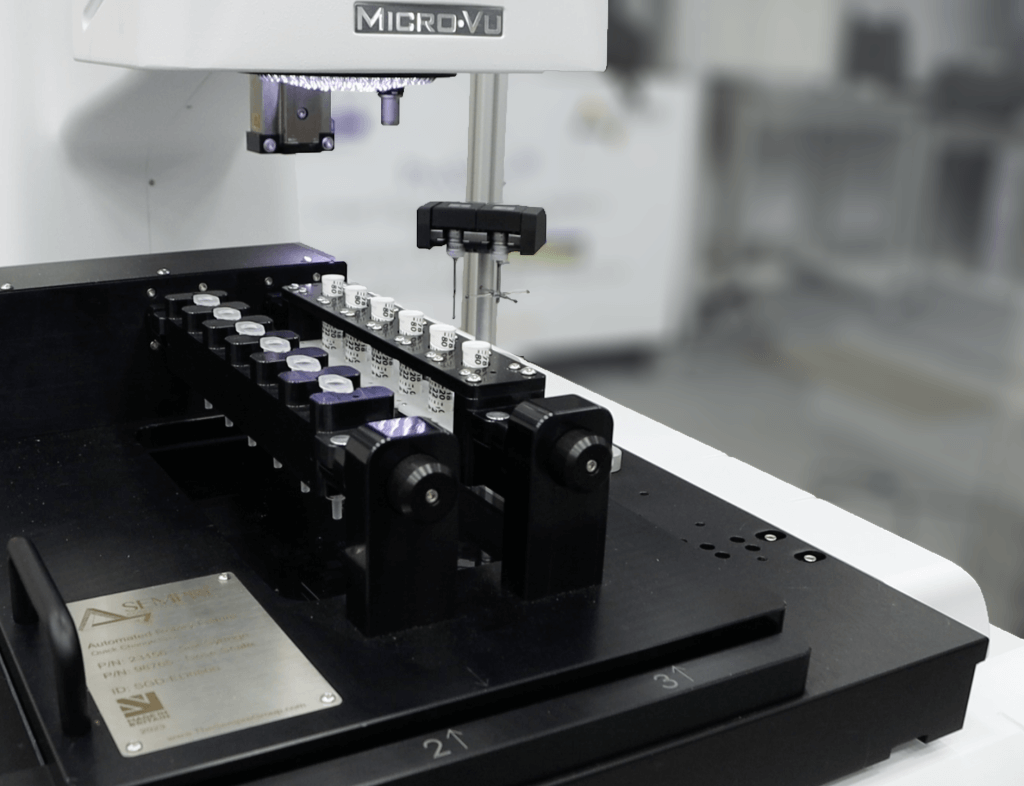
Advanced products such as the Micro-Vu do away with probes and the risk of contact damaging delicate surfaces, and opt for optical systems instead. These optical CMMs capture thousands of data points instantly, recording a level of data that manual inspection could never achieve.
Not only is the automation faster and more comprehensive, but the data itself is easier to store, share, and compare against, providing richer analysis for key decision makers and supporting continuous improvement.
When choosing an automated optical inspection system that provides you with all the benefits outlined so far, the Micro-Vu range is the smart choice.
Instantly, the Micro-Vu can deliver versatile, high-accuracy inspection on precision parts. It does this through a powerful combination of precision optics, touch probes, and laser measurements.
It is a holistic optical CMM and can easily inspect parts which are characterised by internal features – bores, cones, reflective surfaces, etc, thanks to its 360° inspection capabilities.
Micro‑Vu systems are core to The Sempre Group’s industrial metrology offering, combining optical, tactile, and laser measurement for precision parts.
Micro-Vu is ideal for teams that lack inspection experience, thanks to intuitive software, making it easy to get thorough measurements without assistance.
Parts that Micro-Vu can measure:
Parts such as these often have delicate surfaces or intricate components that run the risk of being damaged by invasive probes. Optical systems avoid this by capturing high-resolution data non-invasively.
Tier 1 manufacturers who are looking to scale output in a way that doesn’t sacrifice the quality of their product, look no further than the non-invasive, intuitive Micro-Vu measuring system that offers high repeatability and low cycle times.
Frustrated with slow inspections and inconsistent results? Contact us to discover how Micro-Vu systems can transform your process.
Here’s how Micro-Vu compares to manual inspection tools across key criteria.
| Manual | Optical CMMs |
| Only a few discrete parts are measured | Thousands of data points are scanned at once |
| Set up and human error mean longer measurement times | Inspections can take less than 60 seconds |
| Invasive probes risk damaging delicate surfaces and components | No mechanical wear or probe-induced damage on sensitive surfaces |
| Manual input of CMM data, risk errors, and inconsistencies | Micro-Vu seamlessly integrates with data systems |
| CMMs are larger and slower, often held far from the production line | Micro-Vu’s small footprint allows it to be placed near production lines for faster inspection. |
Manual inspection brings more than just risk. It introduces inefficiencies, inconsistencies, and compliance headaches. With Micro-Vu, critical challenges faced by Tier 1 firms are eliminated overnight thanks to its intuitive software and optical CMMs. Here’s how Micro-Vu overcomes other key issues.
“Why is inspection holding up production?”
Micro-Vu’s automated measuring reduces inspection time to seconds, no matter how complex or sensitive the part is. In a moment, you’ll have all the relevant data you need in front of you all while your lines continue to move, reducing crippling bottlenecks.
“How do I prove we’re compliant without spending hours on paperwork?”
Audit-ready results are instantly available with Micro-Vu. The data captured is stored, traceable, and always compliant with key processes such as ISO, PPAP, and FAI.
“What if we don’t have the right people to run it?”
The intuitive software makes operating Micro-Vu simple. The system guides line workers through each step, ensuring measurement quality is not compromised, reducing dependency on senior team members.
“Why are we still scrapping parts at the final stage?”
Micro-Vu’s footprint allows for in-line measurements and inspection. This immediacy allows team members to spot errors and issues before the final stage, reducing costly waste.
“How do we scale quality control as we grow?”
Whether it’s a new product line or compliance standard, Micro-Vu is designed to be scalable and always ready to provide accurate results again and again.
An established Tier 1 manufacturer who produces medical plastic components was enduring 15-minute measuring times per part when using shadow graphs to inspect important slot dimensions.
The obvious drawbacks here were causing expensive in-line bottlenecks for the manufacturer, who felt they had no choice but to continue wasting minutes to ensure accurate measurements.
However, after transitioning their manual measuring processes to the Micro-Vu, the inspection, which took 15 minutes, now takes just 90 seconds, a 90% time reduction, while also delivering greater accuracy.
In a matter of seconds, the business had reduced operator time while improving reliability. These benefits were exemplified in an external audit that the business was asked to take part in. Thanks to the traceable, digital inspection records the Micro-Vu holds, they passed with zero non-conformities.
From a workforce perspective, the 90% reduction in measuring time and intuitive software allowed inspectors to focus on critical tasks and continuous improvement.
Having seen why manufacturers are moving to automation and the real-world benefits of optical CMMs such as Micro-Vu, the next logical step is to consider what needs to happen to make this transition for your own Tier 1 manufacturer.
Here they are:
We have a range of Micro-Vus to explore, all of which offer different solutions to a multitude of pain points surrounding your parts and production goals.
For those ready to learn more, book a free demo or inspection time study to see the benefits of Micro-Vu first-hand. Working with Sempre guarantees access to our training, calibration, and fixture design services that will maximise your investment in Micro-Vu from day one.
Ready to elevate your industrial metrology capabilities? Contact The Sempre Group to explore the full Micro‑Vu range today. Request A Demo.
